
Most golfers remember their best round. Fewer remember their average round — or whether that average is actually moving in the right direction. If you want to get better, you need to know where you stand. Tracking your golf progress over time is the simplest way to turn vague feelings into facts, and it doesn't have to be complicated.
Why tracking beats memory
Our brains are terrible at judging progress. A great round last month feels like "I'm improving," while three bad holes yesterday feel like "I'm getting worse." The truth is usually somewhere in between — and only data will tell you where.
Tracking gives you three things memory can't:
- Objectivity. A number doesn't care about your mood.
- Patterns. You'll spot trends — good and bad — that single rounds hide.
- Motivation. Seeing a line trend downward (or upward, depending on what you're measuring) is one of the best feelings in golf.
What to track
You don't need to log every stat under the sun. Start simple and add detail as you go:
| What to track | Why it matters | |---|---| | Score | The bottom line. Everything else feeds into this. | | Course & tees played | A 95 on a tough links course and a 95 on a short parkland course are very different performances. | | Fairways hit | Tells you if your driving is costing you strokes. | | Greens in regulation | Reveals how your approach play is holding up. | | Putts per round | Separates a good ball-striking day from a scrambling day. |
Even just score, course, and date is enough to start seeing trends.
How to do it
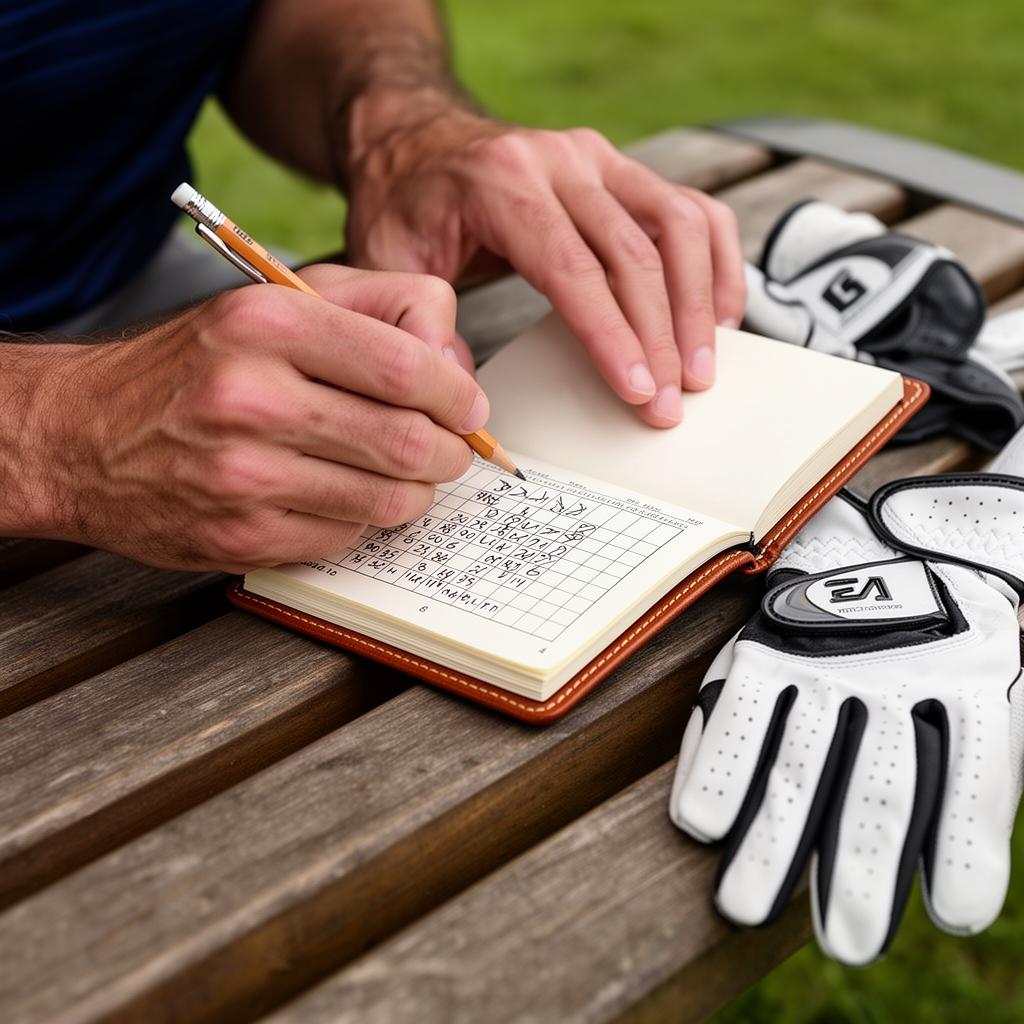
The notebook method
Plenty of great golfers still carry a small score-tracking notebook. Write down your score for each hole, add a note about the weather or a standout shot, and tally it up at the end. Review your last 10 or 20 rounds once a month. You'll be amazed what jumps out.
The spreadsheet method
A simple spreadsheet with columns for date, course, score, fairways, GIR, and putts is surprisingly powerful. You can chart trends, calculate averages, and filter by course or time period in seconds.
The app method
Apps like TrackPar do the heavy lifting for you. Log your round and the app calculates your handicap, averages, and trends automatically. You get charts without the spreadsheet work, and your data is always with you.
What to look for in your data
Once you've got a few rounds logged, ask yourself:
- Is my average score trending down? That's the clearest sign of improvement.
- Am I consistent? A shrinking gap between your best and worst scores often matters more than one great round.
- Where do the strokes go? If your putts are climbing while your GIR stays flat, you know where to spend your practice time.
- Do I score better on certain courses or tee boxes? Sometimes the easiest improvement is simply playing the right tees.
The magic number: your handicap
Your handicap index is the single most useful progress tracker in golf. It condenses your last 20 rounds into one honest number that updates as you play. Watching it drop — even by half a point — is concrete proof that your work is paying off.
If you don't have a handicap yet, logging just 3–5 rounds with course ratings is enough to get a starter index. From there, every round refines it.
Start today
You don't need 20 rounds of history to begin. You need one round, logged properly. Every round after that makes the picture clearer.
The golfers who improve fastest aren't always the ones who practise hardest. They're the ones who know what's working — because they took the time to track it.
Related reading
- How to lower my golf handicap? — the natural next step once you're tracking: a simple plan to turn the data you're collecting into a lower number.
- Understanding the Golf Handicap Calculator — a deeper look at how each logged round feeds into your handicap index.